Chapter 9 - The Long Passage to the Marquesas Anchors AweighAs soon as we cleared the harbor, the engine was turned off. Conserving diesel is going to be extremely important. Our ample diesel supply can take us about 800 miles at most. That's why we're prepared to squeeze every knot out of the wind. Upon leaving the harbor, our thoughts aren't on light winds. We're apprehensive about the large waves and high winds that we could be heading into. The ham radio has kept us up to date with the cruisers who are preceding us. This last week there was a large storm, the same one that closed the harbor yesterday, which brought 18 foot waves and 35 knot winds to a few unlucky sailors. That's the kind of uncomfortable sailing we hope we can avoid. Let's be lucky! The weather fax from the night before showed that the bad storm had passed us by, and the weather looked clear. This looked like a good time to leave.
Seafarers' Roll CallAt 10 PM we officially checked in with the Seafarers' Roll Call, on frequency 14.313. We're boat number 18. Every night, in the same roll call order, boats check in with the net. Each boat provides its latitude, longitude, compass heading, boat speed, wind speed, wind direction, sea condition, cloud cover, and barometric pressure. Messages can also be taken or sent at this time. In this manner we can keep tabs on the other cruisers out there, and be prepared for upcoming weather. The net controller also tells us what's ahead and provides suggested course changes to avoid as much bad weather as possible. If anyone fails to check in after a few days, search and rescue efforts can be initiated by the net. Although the regimen is too much for some, we think the Roll Call is a great idea. Chuck and Bev, on Carina, left two days before us from Zihuatenejo, 100 miles northwest of Acapulco, and are number 14 on the roll call. They started out 450 miles southeast of us, but could have lighter winds and not arrive at Hiva Oa any earlier than we do.
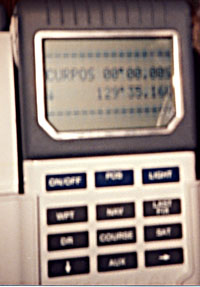
The First WeekThis first day at sea, we had good winds, in the 15-18 knot range, and made fine progress. The seas were somewhat lumpy from the prior storm. Candace always has some seasick problems the first few days out, while I feel just a little under the weather. This time was no exception. The second day is like the first . . . winds to 18 knots and lumpy seas. For a few hours, there's hardly any wind, but on this day we still cover 120 miles, straight toward our target. We're both still looking for our sea legs. Candace doesn't think she ever owned any! My biggest problem is sleeping. With the noise and motion of the boat, I have a hard time getting to sleep. This problem is heightened by sore leg muscles. Especially when it's rough, you have to continually balance yourself, and move from hand rail to hand rail. All that uses different muscles in your legs, feet, and arms. After 48 hours of continually bracing yourself and getting used to the wave motion, your legs really get a workout. Aspirin usually helps. The seas smooth out for the third day, with steady winds in the 9-12 knot range. Then the winds slacken, so we motor to charge the batteries and make some hot water, as well as to move forward. After a hot shower, shave, and clean clothes, I feel great. Candace also feels better, but not 100%. We have corn beef hash to celebrate Saint Paddy's Day. Certainly there's no better oxymoron than "Irish cuisine." Now I'm into the routine and enjoying it. At night, during my watch, I use the computer to work on some pet projects. With an unobstructed view of the entire night sky, I learn more and more about stars and constellations. The Southern Cross, low on the horizon to the south, doesn't seem as impressive as I'd expected. All night long, Baba BarAnn glides through the sea, ticking off the miles at a steady pace. Our GPS tells us we've passed another milestone . . . "TO HIVAOA 2497 miles" Hey, that's less than 2,500! After the fourth day, when we're about 200 miles SW of Cabo San Lucas, the winds die. The Seafarer's net has warned us of a high pressure area that was "taking" all the wind. Not that we can do anything about it, but it's nice to know somebody understands. Now Baba BarAnn rolls from side to side in the sloppy waves, making little progress. Life on board is pretty uncomfortable. Even though sea sickness is not a problem any longer, the violent rocking back and forth, with the mainsail slatting and banging, is very tiring. Days four, five and six we average only 75 miles. Where are the trade winds and the nice, widely spaced, ocean rollers? Our daily routine is settling into some semblance of a pattern. In the morning, at 1600 zulu, we have a "sked" with Chuck on Carina. Ham radio and sailors seem to call it "zulu" time, but it's also known as Universal Coordinated Time, UTC or Greenwich Mean Time, GMT. It's what the little hand says in England, regardless of what your local time says! Anyway, at 1600z, or 0800 MST, we talk with Chuck for about 30 minutes. We exchange information on our lat/lon [chart for the passage] , the weather, what sail combinations seem to be working, and what new birds or sights we've seen. With all our radio contact, it's hard to believe that we haven't seen them since Christmas Day. After breakfast and radio, I try to rest for a few hours. We read, rest, work on the computer, rest, have a meal, rest, trim sails/navigate, rest. I think you've got the beat now! Candace takes the early evening watch, and checks in with the Seafarer's Roll Call. Sometime between 11 and 12, I take the watch until the early morning. Despite all the "sack time," I think I'm sleeping only 3 or at most 4 hours per day. Evening watch means poking your head out of the cabin every half hour or so and looking around for boats. We seem to see one in the distance about every three days. Often we set the "minute minder" alarm for 30 or 45 minutes and then nap until its time to look around again. The more active responsibility is to keep the boat sailing as well as possible in the correct direction. While sailing on a broad reach in light air, a large wave can force us to jibe. This has to be corrected ASAP. I've rigged an extremely strong "preventer." It consists of one inch line, looped around the boom, then around a large rubber snubber (18 inches long by 1.5 inches in diameter), and tied off on a large cleat. If we jibe in a hurricane, the boom will still stay put. There's no fear of the boom flying across and decapitating someone, or smashing into the shrouds on the other side. The rubber snubber really cushions everything and takes all the abuse. We also have a boom brake to control our intentional jibes.
Head WarsThe day before leaving Mazatlan, I noticed a small, hairline crack, in the base of the commode, which resulted in a very small leak. I sent a letter off to the manufacturer requesting a new base be sent to Nuka Hiva in the Marquesas (hopefully under warranty). It would take several days to get a replacement shipped to Mazatlan, and the leak seemed minor enough that we shouldn't have a problem. Now, one week out to sea, the leak seemed a little bigger, and we were having some other problems with the "head." I took the entire head out, cleaned everything up, and tried to seal the hairline fracture in the plastic base with the soldering iron, melting the plastic together. Of course we were worried about making it much worse. It took all day to complete this project, because everything is so tight, compact, and difficult to reach. At first, it seemed like our problems were solved, then, the next day, we had a major problem. Nothing would flush. Pressure on the hand pump resulted in sewage being forced through the vents in the holding tank and onto the deck. Yuck! I closed the seacocks for both the sea water intake and the toilet discharge, and started to disassemble everything. The intake system was fine. But the outflow hoses, from the head to the Y-valve (to direct discharge overboard or to the holding tank), to the anti-siphon valve (which prevents sea water from siphoning into and flooding the boat), and all the way to the through hull, were completely clogged. Urine and sea water combine to form calcium chloride deposits that gradually closed off the hose, something like arteriole sclerosis. I'd heard about the problem, but had no idea it could occur so rapidly. The repair books suggest replacing the hose, rather than trying to breakup the deposit by beating the hoses on the dock. Great. I don't even have a dock. It was very difficult removing the hoses. It took more than two hours to remove about fifteen feet of hoses that were tightly packed in and around the head. Once removed, the hoses were then "whomped" on the side of the boat and we gradually cleaned them out completely. Of course all this activity was taking place while we were sailing along at 5 or 6 six knots. Somehow I missed this chapter when I was reading the books on sailing to paradise! By far the hardest part was putting all the hoses back into their nice tight cubbyholes. Except for the tiny leak that is still in the base of the commode, the head now works perfectly. While fixing the head I discovered that the Y-valve was installed improperly. I even think it was designed improperly. Because of the tight, cramped quarters where all the plumbing is jammed, the cure is more complicated than switching a few hoses around. I'll get to that later.
First Big StormOur weather for the first 10 days at sea was pretty good. Except for those three light air days, and sloppy seas, it was pleasant. No rain, and lots of sunshine. On the evening of March 26 the wind started to pick up. At 18 knots we reefed the mainsail. At 25 knots we rolled in the genoa, and sailed with just the staysail and reefed main. At 32 knots we tucked another reef in the mainsail. Luckily, the wind was from the northeast, pushing us in the desired southwesterly direction. Then it started to rain, and the wind picked up even more. Because the seas were fairly calm, and we were moving rapidly in the right direction, I didn't want to reduce sail even more. How much more does this storm have in it. After two hours, the wind peaked at 39 knots before it subsided. [Wind speeds in this journal are always shown as Apparent wind speed. In this situation, the true wind speed was approximately 44 knots] By now the seas had "come to the party" and had built up to the ten foot level, but the winds had dropped to only 15, leaving us with uncomfortably sloppy waves. At 3 AM the control lines to the Monitor wind vane chose to break. Luckily we still had our electric autopilot. At dawn, we hove to for an hour while I put new control lines in the windvane. Then we were back under way none the worse for the storm. In retrospect storms at sea aren't so bad. In retrospect you KNOW you've survived. The most unnerving aspect of any storm at sea is the uncertainty of its magnitude. You can't turn to the last page in the book to find out how it all turns out. Will 39 knots escalate to 60 knots? How high will the seas get? Will any equipment break? You're all alone, in the middle of the ocean, waiting for the "shit to hit the fan," knowing you have to solve whatever problems come your way. The 1600 zulu schedule with Carina has expanded, by our invitation, to 8 boats: Arjumand, Menehune, Kokana, Amazing Grace, Orca, Journey, Carina, and Baba BarAnn. We're all going to the Marquesas at about the same time, and are within 600-700 miles of each other. This encompasses a "small" region of about 400,000 square miles in the eastern Pacific. The morning after the storm, our local ham net was really buzzing with horror stories. The boat that was closest to us, Journey, had its steering break as a 65 knot gust had a different idea on where the boat should head. Eventually they got their emergency tiller attached, but after some pretty scary moments. They also had a spinnaker halyard wrap around the forestay and a few other ugly situations. With lots of help over the radio from Ralph on Arjumand, who was about 200 miles further down the line, they jury rigged a good fix. The steering cable had broken and needed replacement. Of course Journey didn't have any spare steering cable, but Ralph suggested pirating a safety line from the stanchions, which would be just about the right diameter. It worked fine. That night, Journey just hove to and went to sleep for the night to recover. However, they were only 35 miles downwind from us, and potentially right in our path. We were especially observant on watch that night, but never did see them. From several other conversations, I've come to believe that Ralph knows more, about "all this stuff" than anyone I've ever talked to. I'm looking forward to meeting him in Hiva Oa. Downwind SailingFinally the NE trade winds materialized and we shifted from a broad reach to directly downwind. Now we could try our downwind pole for the first time since I made some changes back in Seattle. After some experimentation, during which Candace swore I'd be decapitated, we got it to work perfectly. With the genoa held out snugly to port by the pole, and the mainsail held out to starboard with the hefty preventer, we ran straight downwind. The windvane loved this arrangement, and kept us right on track. Day and night we slid over the water, on our 220 degree magnetic course to the Marquesas. In the past we'd always had problems with the pole. Gradually we worked them all out, with a little help from Ralph.
ITCZ - Inter Tropical Convergence ZoneNorth of the Equator the trade winds blow steadily, 10-20 knots, from the NE. Well, at least they do in the text books. South of the Equator, the trade winds are from the SE. Both areas have a westerly setting current of about one knot. In between these two bands of trade winds is the Inter Tropical Convergence Zone, or the ITCZ. This area is sometimes called the "doldrums." It's characterized by light winds, squalls, lots of lightning, rain, and a counter current, flowing eastward at almost one knot. We can't avoid this area, but would sure like to skip over it as rapidly as possible. This time of year, the ITCZ is centered around 6-10 degrees North latitude. Our game plan is to head straight south as soon as we're in the ITCZ. If our winds die, we're prepared to burn some diesel in order to get this area behind us. Most of the cruisers ahead of us left Mexico from ports southeast of Mazatlan, and thus arrived at the ITCZ further east than we had planned. It sounded like the ITCZ was uglier, the further east you crossed it. Thus, we took a more westerly path, and met the ITCZ at longitude 122 degrees West. Another reason for a more westerly crossing of the ITCZ was to delay getting into the SE trades, since they tend to be lighter than the NE trade winds at this time of year. Finally, the westerly entry into the southern hemisphere would result in a beam reach, or broad reach, to the Marquesas, rather than a downwind run. In light airs, reaching is better and faster than running. Almost all of this planning turned out as desired. In the ITCZ, we encountered a stiff countercurrent at 9 degrees north, and a few short squalls, but in general had no problem with it. We didn't experience any lightning storms, although we could see them in the distance. Our weather was pretty good. The real advantage was being able to beam reach rapidly toward the Marquesas, once we hit the SE trades. Not only did we go faster, but we could cut across the weather patterns. The squall lines go with the wind, from the E or SE. The cruisers that crossed the ITCZ early and had a downhill run to the Marquesas, got stuck in storms for days. Their only respite was to head south, away from the Marquesas, to get out of the storm's path. This not only resulted in a longer trip, but the problem recurred once they got hung up in the next squall line.
Shell Backs
The sun, on March 21, had just crossed the Equator on its way north for the summer. We sailed directly under it at 4 degrees north. Neither Candace nor I had ever been south of the sun before and we were looking forward to our first moments in the southern hemisphere. Until you've sailed across the equator,
The Home Stretch
Once through the ITCZ and south of the equator, we really ticked off the miles. The first day 147 miles, then 161 miles, and then 160 the third day. Formerly, our best day was only 131 miles. Everyday, we got closer and closer to Carina. By April 7, we had cut her "lead" down to a mere 35 miles. Both of us were now shortening sail in order to arrive at Hiva Oa in the morning of April 9, rather than get there at night and have to wait around for daylight before entering the harbor. But the winds really picked up those last few days, and we arrived at the east end of Hiva Oa at 3:30 AM. After three months, and countless ham radio conversations, we finally spotted Carina's lights, and he saw ours. By now we were talking on the VHF since we were only a few miles apart. We hove to and slept until 6:30, before continuing into the harbor at Atuona. The passage took us a respectable 25 days. We think we had better weather and better winds, with fewer problems than most cruisers on this passage. Just the same, it was quite difficult. It wasn't fun, or relaxing, like we had read about. The continual motion, and rocking back and forth, got extremely tiring. Cooking in the galley was especially arduous. If we set a cup down, it was bound to spill . . . we had to keep one hand on everything! Walking anywhere on the boat, we had to use the hand rails. Our arms and legs were continually being used to maintain balance. After a few weeks of this, they rebelled. When they let us down, we got thrown around the boat. That's what happened when the weather was good! At a pot luck dinner a few days later, we compared notes with the other cruisers; 100% of the women, and 75% of the men thought the passage was very difficult, and not much fun.
|